
Anderson Released Mugshot Records
A mugshot, also called a booking photograph, records appearance during an arrest or admission. Release does not change what the image documents. It still concerns the earlier booking. The photo cannot establish the final charge, case outcome, exact release time, or whether another agency took custody.
South Carolina public access is subject to exemptions, redaction, and expungement law. The best source is the custodian of the booking. Anderson County Sheriff’s Office holds county-jail material. Anderson Police Department holds its municipal booking material. SCDC controls state-prison photographs for people who entered state custody.
Use a photo as an identity aid only after matching the name, birth information, booking date, arresting agency, charge, or booking number. Common names and old images can lead to a false match. The related release record should be checked separately.
Find Anderson County Booking Photos
Anderson has several official channels, but none is a permanent gallery of all released people. The ACSO portal is described as “Inmate Search/Bookings.” Its public shell did not allow a reliable promise that every live result has a photo or that an image stays after release. APD operates a separate search. Do not mix the two systems.
| Channel | Photo availability | How to access |
|---|---|---|
| ACSO booking portal | Possible on a live booking result; verify the field | Search the official county portal, then confirm the event with ACSO. |
| APD inmate system | Possible; municipal records are separate | Use APD’s linked search or its Records Division. |
| ACSO records request | Requestable when releasable | Name the booking and ask for the photograph as a separate item. |
| SCDC current search | Official photos for current state inmates | Use only if the person entered SCDC. |
| Anderson SLED registry | May show multiple photos for a qualifying registrant | Use only for the limited statutory registry population. |
| Agency or news archive | May preserve an older arrest photo | Treat it as historical context and verify against official records. |
VINELink can help locate a participating custody record, but the research did not establish it as a lasting Anderson booking-photo archive. A photo found beside a current record still does not prove the person remains jailed.
The image below comes from the official ACSO current booking portal.
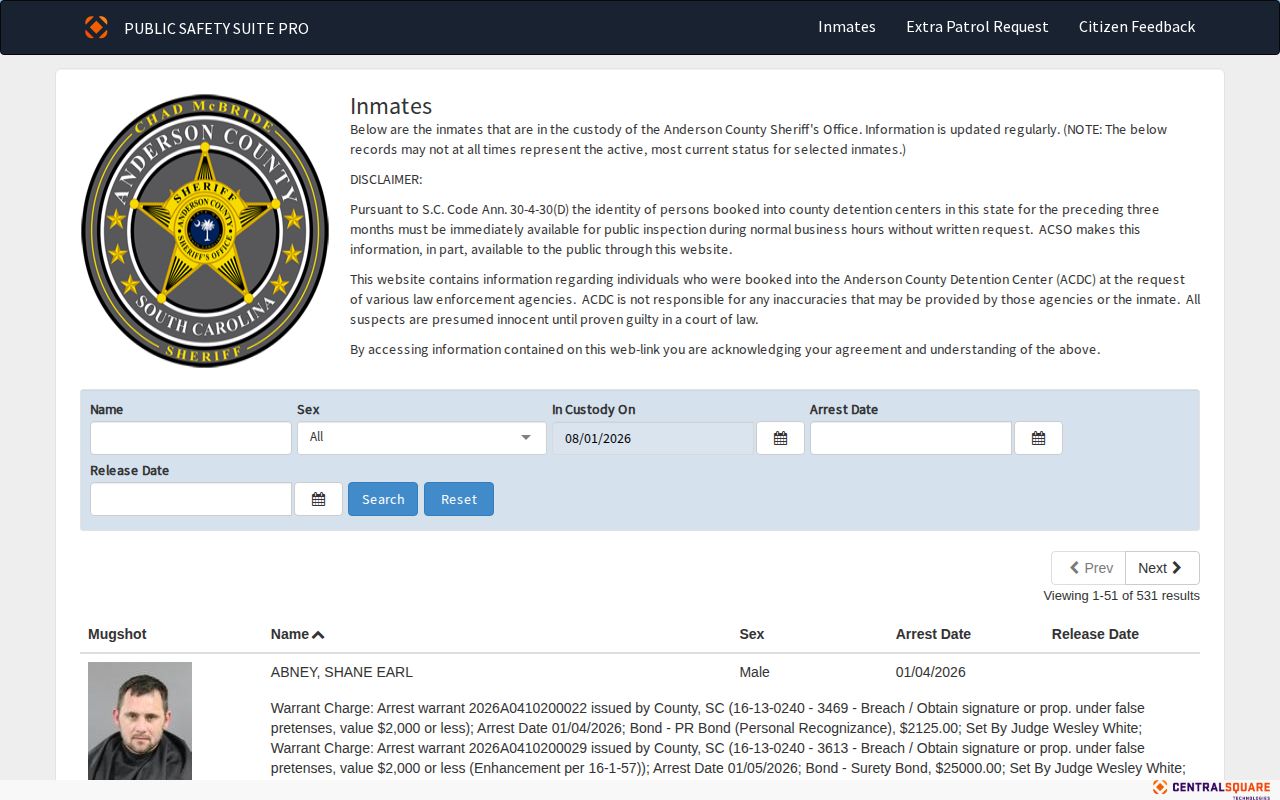
That portal is a current-custody starting point. Its absence or removal cannot establish that a person was released into the community.
Anderson Sheriff App Mix-Up
No Anderson County, South Carolina sheriff mobile app with inmate lookup, recent releases, or mugshots was verified in ACSO’s official links. A search result with the title “Anderson County Sheriff” belongs to the sheriff’s office in Tennessee. The matching county name makes that result especially misleading.
Check both the state and store publisher before trusting an app. For local county records, follow the portal linked by the South Carolina ACSO Detention Bureau. Do not treat an app from another state as a local record source. The official Anderson County 24-hour release page also explains why the active portal is not a published recent-release feed.
This distinction affects photos as well as status. A photograph from the wrong Anderson County does not identify a South Carolina booking.
Request Anderson County Mugshots
A focused request is the most durable official path after a live entry disappears. Ask for the booking photograph separately from the movement or release transaction. That lets ACSO grant, redact, withhold, or price each record on its own terms.
- Identify the person with the booked name and a date-of-birth discriminator.
- Provide the approximate arrest or booking date, arresting agency, and booking number if known.
- Ask specifically for the releasable booking photograph from that event.
- Ask separately for release date, time, disposition, and destination if release proof is also needed.
- Request electronic delivery and an advance estimate above a chosen cost limit.
- Preserve the response and any cited exemption or redaction reason.
The ACSO FOIA page accepts written requests by email or mail, and its form is optional. The published schedule lists $5 for a CD or DVD and $15 for an agency-provided USB drive up to 2GB, plus staff time when applicable. An existing electronic image may be sent by email without a per-page charge. Fees do not guarantee disclosure.
The official request page is shown below because it is the county channel for a booking photo that no longer appears online.
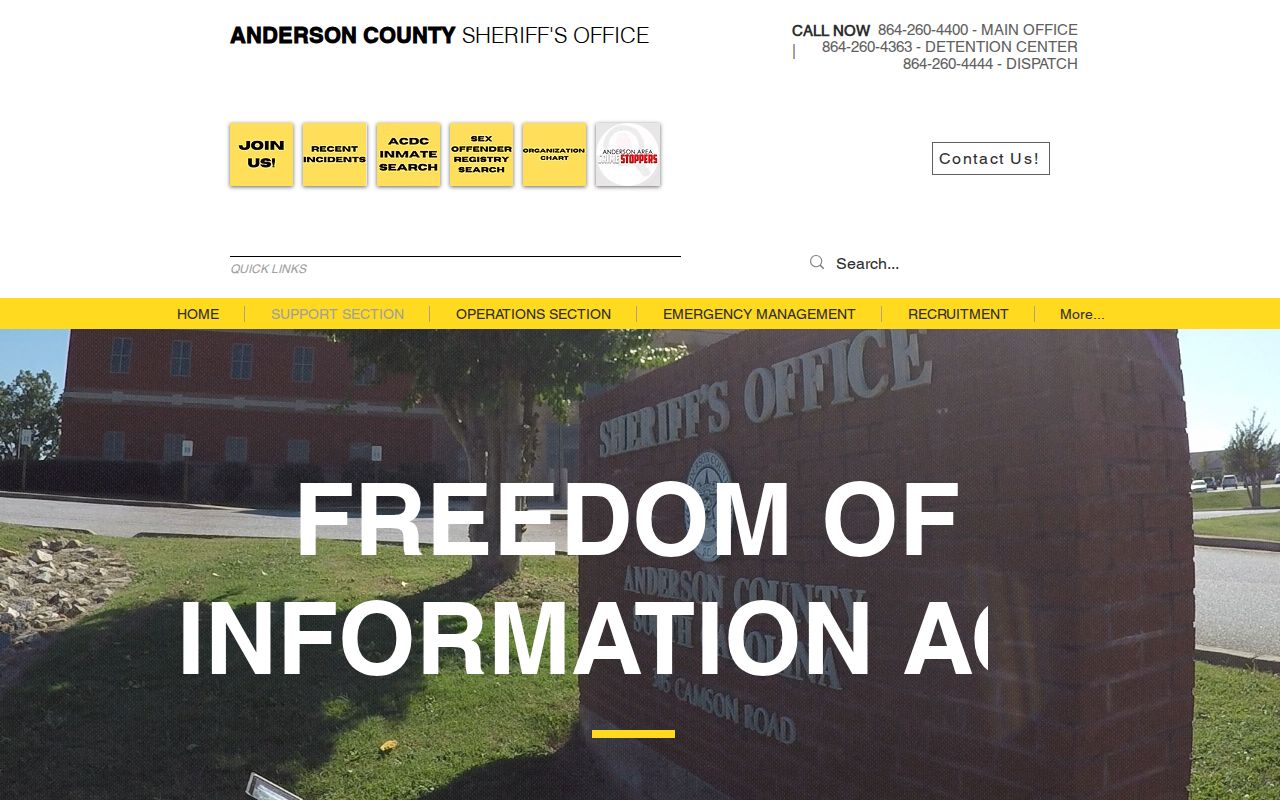
A narrow description helps ACSO locate one event and avoids confusing a booking image with the separate proof of release.
Anderson City and SCDC Photos
An APD booking belongs to the city system. APD links its own BluHorse search and directs “City inmate release date or charges” questions to 864-231-2277. For the image itself, contact APD Records. Do not assume ACSO holds a city photograph just because both agencies operate in Anderson.
An SCDC photo is appropriate only when the person entered South Carolina prison custody. The official current-inmate search displays photos and public data for current inmates, but excludes released offenders. A historical state photo may require a lawful request to SCDC. It also does not substitute for the earlier county or city booking image.
Custody sequence explains the difference. A felony defendant may leave Anderson County Detention Center through a transfer to SCDC. The county image marks the local booking; the SCDC image marks state-prison custody. Neither image alone proves a later discharge.
Anderson Registry Photo Limits
The official Anderson SLED-powered registry may show aliases, reported residence information, convictions, and multiple photographs over time for a person required to register. It is not a general list of released inmates. A match establishes a public registration record, not the date of jail or prison release.
A non-result says nothing about most people released from custody because the registry covers only a statutory class. SLED also warns that details can change fast and some data may be supplied by registrants while verification is pending. Removal from the registry can follow a lawful process and does not prove a new custody event.
Official agency press releases and reputable local reporting may retain an arrest photograph after a roster changes. Such publication is historical. It should be traced to the named agency and checked against the court disposition. Commercial mirrors may surface old images, but their dates, corrections, and status claims are not authoritative. No commercial mugshot or data-broker link is needed to verify an Anderson event.
Anderson Mugshot Expungement Route
Release and expungement are separate. Release ends or changes custody. Expungement is a legal process that can remove qualifying arrest and booking material from public access. The Tenth Judicial Circuit Solicitor serves Anderson County and accepts completed applications at andersonexpungements@solicitor10.org. Eligibility and any current fee come from that office’s current page and form.
Under S.C. Code §17-1-40, qualifying government arrest and booking records, warrants, mugshots, and fingerprints are destroyed or retained under seal as the law directs. A detention or correctional facility may keep sealed institutional material for up to three years and 120 days from the order for specified institutional or litigation needs. It is not public without a court order and generally must later be destroyed unless a listed action or inquiry continues.
The same statute sets duties for entities publishing South Carolina arrest and booking records. In qualifying cases they may not demand payment or other consideration for required removal. When charges were discharged or dismissed because the person pleaded to a lesser or different offense, a qualifying publisher may keep the item but must revise it to reflect the resulting offense within 30 days after a proper request, without payment.
No removal service can decide whether Anderson records qualify for expungement. Use the Tenth Circuit process, send any order to the official custodian, and ask a publisher for correction or removal only under the facts and law that apply. Never republish an image known to have been lawfully expunged.
Verify Anderson Mugshot Context
A photograph proves that an image was associated with a record, nothing more. Match it to the correct agency and booking. Then read the Anderson court disposition for the result and obtain the custodian’s release transaction for the physical exit. A dismissal may explain the case outcome but not the jail’s door time. A transfer may remove the person from a local roster while confinement continues.
If an official source conflicts with a captured page, preserve the capture date and ask the custodian to correct the record. Prefer a corrected or certified response. If ACSO releases the movement record but withholds the photograph, the release can still be verified without the image.
That order of work protects both accuracy and dignity: identify the event, confirm the outcome, and treat the photo as a limited booking record rather than a current label.