
Anderson Projected Versus Actual Release
SCDC’s official label is “Projected Release Date.” It is the date on which the department expects a current state prisoner to satisfy all incarcerated terms, based on sentence type and an assumption that work, education, and good-time credits continue at the current rate. The date can move. It is not an appointment or promise.
An actual release is a completed custody transaction. It has a real date, time, disposition, and destination. The person might enter the community, begin supervision, or move to another custodian because of a detainer. A detainer is another agency’s request to hold or receive someone.
A pretrial Anderson County detainee has no sentence-derived release date. Bond, dismissal, plea, trial, court order, or a hold may decide what happens next. A person serving only a local jail term also falls outside SCDC’s public projected-date field.
Find Anderson County Release Dates
Start with custody type. A person at Anderson County Detention Center may be awaiting court, serving a local sentence, or waiting for transfer. A person in SCDC serves a state sentence. Those situations use different records.
- Check the Anderson jail or court record to learn whether the case is pretrial, locally sentenced, or committed to SCDC.
- For current state custody, search the SCDC inmate application by SCDC ID, SID, first name, or last name.
- Open the correct detail and copy the Projected Release Date exactly as displayed.
- For a county sentence, obtain the commitment order and ask ACSO for the current calculation.
- For a completed state term, use the separate SCDC Released Inmate List and confirm any supervision or detainer.
The general Anderson County released inmate lookup helps distinguish a release from a transfer when the person has disappeared from the jail portal.
The official SCDC search shown below is for people currently sentenced to and incarcerated in SCDC.
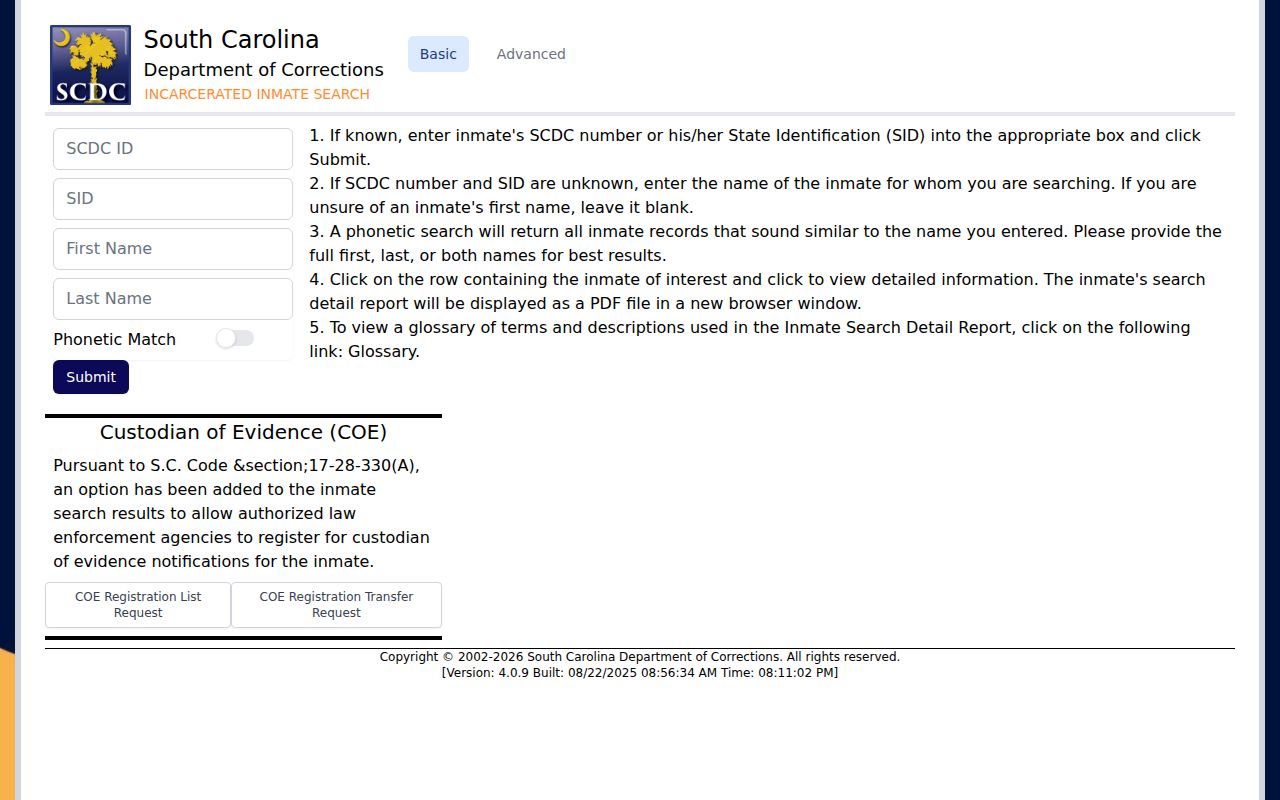
Its prior-midnight scope means it is neither a live Anderson jail roster nor a record of people already released from SCDC.
SCDC Projected Release Date Fields
The basic SCDC application accepts SCDC ID, SID, first name, and last name. Advanced search adds Projected Release Date start and end criteria. Identity matching matters because a similar name can produce the wrong sentence history.
| Official item | Use and limit |
|---|---|
| Projected Release Date | Estimate for the end of all incarcerated terms at the current credit rate. |
| Projected Parole Eligibility | Possible eligibility or a scheduled hearing, not a grant or release. |
| Current location | SCDC placement as reflected in prior-midnight data. |
| Sentence and offenses | Context for the controlling term, not a personal recalculation tool. |
| Released Inmate List | Separate date-and-county list for completed SCDC departure events. |
SCDC’s released list can be filtered by a date range and Anderson county. Visible results include SCDC ID, name, sex, race, age, release date, release type, and county. Exported data adds items such as SID, detainer, and most serious offense. The county column does not turn a state-prison departure into an Anderson County jail release.
The SCDC calculation tool supplies only a general, earliest-possible scenario. Its own terms say it assumes all possible credit, cannot determine an already-sentenced person’s actual date, excludes Youthful Offender Act cases, and does not incorporate prior or later convictions. Actual-sentence questions go to SCDC Inmate Records at 803-896-8531.
Anderson Release Credit Rules
South Carolina does not use one flat percentage for all sentences. Under S.C. Code chapter 24-13, a no-parole offense includes specified Class A, B, or C felonies and certain unclassified offenses with a high maximum term. Section 24-13-150 generally requires a person serving a covered no-parole term to serve at least 85 percent of the actual unsuspended prison term before release, discharge, or community supervision. Credits do not reduce that floor.
The 85 percent rule must not be confused with the separate 80 percent work-release eligibility threshold in section 24-13-125. One concerns the minimum service needed for release or discharge. The other concerns work-release eligibility. Sentence calculations use a 365-day year under section 24-13-175.
For an eligible SCDC prisoner not serving a no-parole offense, section 24-13-210 provides twenty days of good-conduct credit for each month served. A covered no-parole prisoner may receive three days per month, subject to the statutory floor. Misconduct can cause forfeiture.
Section 24-13-230 governs productive-duty and education credit. Eligible prisoners outside the no-parole class may earn up to one day for every two days of qualifying work or education. For a no-parole offense, the statute allows six days per month and caps combined work and education credit at 72 days per year. These credits also cannot cut service below the required minimum.
Why Anderson Release Dates Change
SCDC begins with the controlling terms and the judge’s concurrent or consecutive structure. Concurrent terms run together; consecutive terms run one after another. The department then accounts for accepted pre-sentence jail credit, the offense classification, mandatory minimums, and credits projected at the current earning rate.
| Change | Possible effect |
|---|---|
| Disciplinary credit loss | Can move the projected date later. |
| Credit restoration or new earned credit | Can revise the estimate within statutory limits. |
| Corrected jail credit | Changes time credited before SCDC admission. |
| New or corrected sentence | May alter controlling, concurrent, or consecutive terms. |
| Appeal or court order | Can change the legal sentence basis. |
| Parole action | May permit an earlier institutional exit, but eligibility is not a grant. |
| Detainer or hold | May cause transfer instead of community release. |
Community supervision may begin after institutional release and remain part of the sentence. A favorable parole decision is not the door time. Calculation disputes should go to SCDC Inmate Records, not to a homemade estimate built from a statute and a docket.
Anderson County Jail Date Limits
SCDC’s Projected Release Date does not calculate a purely local Anderson sentence. The jail must apply the commitment order, certified jail credit, any lawful local credit, and active holds. No official ACSO source reviewed publishes a county good-time formula, weekend-release rule, or public calculator. Guessing from another county’s practice would be unsafe.
Obtain the sentencing or commitment order from the Anderson court record. Then ask ACSO for the current calculation and, after release, for the completed transaction. If the person is transferred to SCDC, the state system becomes the right source from that point. Leaving the Anderson jail by transfer is not release to the community.
A pretrial person’s timing remains court-driven. A bond order can authorize release, yet jail processing and another hold may delay or redirect the physical exit. The order explains authority; the jail record proves the movement.
Anderson Parole Date Distinctions
Projected Parole Eligibility and Projected Release Date answer separate questions. Eligibility means the law may allow the Board of Paroles and Pardons to consider the person. The Board may grant, deny, defer, or reschedule a matter. A calendar entry is not a decision, and even a favorable decision may carry conditions that must be met before release.
A parole date can therefore sit before the projected end of the institutional term without replacing it. If parole is denied, the SCDC projection still reflects the sentence and credit framework then in force. If parole is granted, confirm the Board result, the later SCDC departure, and the start of SCDPPPS supervision. Supervision is a period in the community under agency rules; discharge means that the supervision or sentence obligation has formally ended.
Detainers complicate the sequence. Another county, state, federal, or immigration agency may receive the person when SCDC releases its hold. In that case, the SCDC date can be accurate while the person does not return to the community. Read the released-list type, exported detainer field when available, and receiving-agency record together.
Confirm Anderson Release Events
Record an SCDC date as “displayed on” the day it was checked. Recheck near the projected date. A pending alert through the Anderson County VINELink check can flag a reported change, but it does not replace the source record.
After a state-prison departure, consult the SCDC Released Inmate List. Release types can include probation, supervised reentry, and community supervision, so a row does not always mean unconditional discharge. Check SCDPPPS when supervision is possible and ask about a detainer when the destination is unclear.
For the county jail, request the movement or release transaction with the date, time, reason, and destination. That record resolves the central question: did the person enter the community, or did another custodian receive them?