
Anderson County Parole and Probation
South Carolina separates the decision to release a person on parole from the work of supervising that person afterward. The South Carolina Board of Paroles and Pardons process handles parole consideration. The South Carolina Department of Probation, Parole and Pardon Services, known as SCDPPPS, supervises qualifying people in Anderson County after release. A supervision record does not give the exact time someone walked out of jail or prison. It shows the community-supervision phase reported by SCDPPPS.
Probation usually comes from a court sentence. Parole is conditional release from a prison term before the sentence is fully discharged. Either may include reporting, treatment, payment, travel, or other case-specific conditions. Those details come from the sentencing order or supervising agent, not from a generic public result. A person can also finish custody without either status. Sentence expiration or discharge may leave no active SCDPPPS listing.
| Point | Parole | Probation |
|---|---|---|
| How it begins | Board-approved conditional prison release | Court-ordered sentence or sentence component |
| Decision source | Board of Paroles and Pardons | Sentencing court |
| Public verification | SCDPPPS offender search, Board result, SCDC release | SCDPPPS offender search and court disposition |
| How it ends | Discharge after the required term or other lawful action | Completion, discharge, revocation, or court action |
Verify Anderson County Release Supervision
The official SCDPPPS offender search is the first public check for active Anderson County parole or probation. It accepts combinations of first and last name, SID, county, and birth year. The research found that its information reflects the prior day, so a same-day change may not appear at once. Match more than a name. A common name, changed county, or stale result can point to the wrong person.
Use a short verification chain. It separates a release event from later supervision and prevents a missing roster entry from becoming an unsupported claim.
- Check the Anderson County or City of Anderson custody source to determine whether the person is still confined.
- Search SCDPPPS with the strongest identifiers available and read the status and assigned county carefully.
- Check the Anderson court disposition if probation was ordered, or the Board and SCDC records if parole is expected.
- Contact the Anderson County SCDPPPS office for a same-day public-status check when the online data is unclear.
- Return to the originating jail or SCDC for the actual release date, type, and destination.
The broader Anderson County released-inmate search path explains how custody, court, and release records fit together when the original holding agency is uncertain.
Anderson County Supervision Office
The local office is the best route for an Anderson-specific public confirmation when yesterday's search data is not enough. Ask whether the public record shows active supervision and which office holds responsibility. Protected treatment, risk, victim, and case-management facts may not be disclosed. The office result also cannot rule out a new arrest. Check current custody separately if there is reason to think the person has been booked again.
South Carolina DPPPS, Anderson County
Street:
200 McGee Road
Anderson, SC
29625
Mail:
P.O. Box 8002
Anderson, SC
29622
Phone: 864-260-2230 or 864-260-2232
Fax:
864-226-8847
The official Anderson County office directory should be checked before a visit because staffing and posted contacts can change. At the research date, Auburn Walker-Callahan was listed as agent in charge. That name identifies the published office contact, not the assigned agent for every Anderson County case.
Note: Call the Anderson office when a same-day change has not yet reached the prior-day public supervision search.
Anderson County Parole Hearing Records
Parole eligibility only allows consideration. It is not a release order. The Board portal searches hearing information by first name, last name, SCDC number, and hearing month in allowed combinations. Schedules are generally finalized and searchable about 30 days before a hearing, but rescheduling is possible. The revised annual calendar groups Full Board, panel, pardon, and administrative dates. It is a planning document, not proof that one Anderson County person's case will be heard that day.
A Board matter may be granted with conditions, rejected with written reasons, taken under advisement, postponed, rescheduled, or rescinded before the grant takes effect. Detainers and pending charges can affect timing. After a rejection, the general rehearing interval described in the official criteria is two years for a violent offense, subject to a legal exception, and one year for a nonviolent offense. The case result controls.
South Carolina Code chapter 24-21 sets the governing framework. Section 24-21-30 addresses Board voting and exclusions. Section 24-21-610 generally links eligibility to a fraction of the term or a mandatory minimum, with separate rules and exclusions for specific offenses. Good behavior alone does not create eligibility. Read the controlling sentence and offense provision before drawing a date conclusion.
| Record | What it can establish |
|---|---|
| Hearing schedule | A planned consideration date, subject to change |
| Board result | The decision or current procedural state |
| SCDC release record | The state-prison release event and reported type |
| SCDPPPS record | Reported community supervision after release |
Anderson County Absconder Status
An absconder is a person whom the supervision agency alleges has stopped reporting or cannot be located as required. That label does not prove the person is in custody. A warrant also does not show that an arrest has occurred. SCDPPPS publishes a Most Wanted offenders page and a tip line at 1-888-761-6175. Treat a listing as an agency lead and confirm any present custody through the agency that would hold the person.
The distinction matters in Anderson County because three statuses can coexist in different systems. SCDPPPS may report a supervision problem. A court may show a warrant or violation filing. The county jail portal may still show no booking. None should be silently converted into a new conviction or an arrest. If urgent public safety is involved, use law enforcement, not a records-search inference.
The manifest includes a successful view of the official wanted-offender source. The SCDPPPS wanted page supplies the proper context for that image.
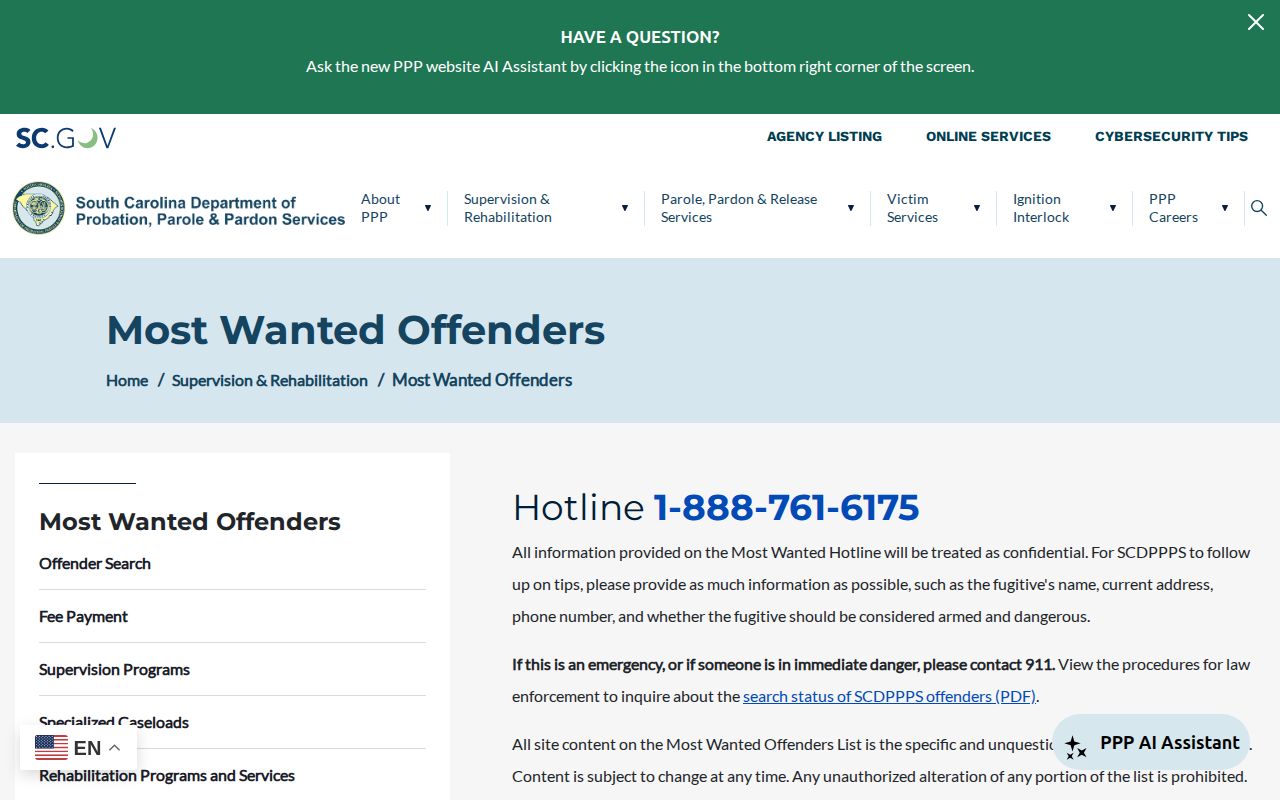
It is an absconder and warrant lead, not an Anderson County jail-release list or proof of present confinement.
Anderson County Supervision Terms
Several records use short corrections terms. Their meanings help keep custody, supervision, and final discharge from being blurred together.
- Parole
- Conditional release from a prison sentence under Board authority and community supervision.
- Probation
- A court-ordered community sentence or sentence component supervised under stated conditions.
- Absconder
- A person alleged to be unavailable or noncompliant with required supervision contact.
- Violation
- An alleged breach of a supervision term, which must be resolved through the proper process.
- Discharge
- The formal end of the applicable sentence or supervision obligation.
Conditions are case-specific. They can include reporting, approved residence, travel limits, payment, treatment, testing, or other terms in the order. A public lookup rarely supplies the whole order. For probation, obtain the court's sentencing record. For parole, use the Board action and supervising agency. If a violation leads to revocation, the new custody record must be checked separately.
Anderson County Release Aftercare
Anderson County's opioid-settlement projects include a Detention Center Treatment Program described as providing detoxification help, addiction treatment, counseling, and post-release aftercare or referrals. This is a local reentry initiative, not a promise that every detained or supervised person qualifies. The county announcement does not publish a separate public intake line. Availability and eligibility should be confirmed with detention staff.
The distinction between treatment support and formal supervision is important. Participation in an Anderson County program does not itself prove parole, probation, discharge, or compliance. SCDPPPS remains the official source for community-supervision status. The county's opioid-settlement project announcement is the source for the program description.
Post-release support may run alongside parole or probation, but the agencies perform different jobs. One provides or refers services. The other applies the court or Board's supervision terms. Keep both contacts current and ask each office only for the part of the record it controls.
Anderson County Supervision Discharge
Supervision ends through a formal discharge, completion, court action, revocation, or another lawful case event. A person who no longer appears in the SCDPPPS search may have completed supervision, moved between offices, had a record updated, or fallen outside the public display. Absence alone is not a discharge certificate. Request the appropriate SCDPPPS or court record when the end date matters.
For qualifying no-parole sentences, section 24-21-560 provides community supervision and advance SCDC notice to SCDPPPS. Successful completion satisfies the sentence and discharge. Parole cases require the Board result, the SCDC exit record, and the later supervision record to tell the full sequence. Probation cases usually rely on the sentencing court and SCDPPPS. Each record proves one stage.
South Carolina VINE can report participating custody or status changes, but it is not the complete supervision file. A VINE alert should lead to confirmation with the jail, SCDC, or SCDPPPS. The safest Anderson County conclusion names the source, its observation date, and whether it proves a custody exit, active supervision, or final discharge.