
Anderson Federal Release Destinations
No BOP prison or ICE detention center was identified in Anderson County. Federal custody still matters locally because APD has historically maintained a federal detention function, and local detainees may move to USMS, BOP, or ICE. That movement ends the local holding event but is not release to the community. The local jail transaction should name the receiving agency when releasable.
A sentenced federal prisoner may leave BOP at the end of the prison term, enter supervised release, transfer to another custodian, or remain subject to another case or detainer. BOP's result answers BOP custody only. It cannot rule out Anderson County custody, South Carolina custody, immigration detention, or community supervision. Use the Anderson County custody search to connect the federal result to any earlier local event.
Search an Anderson Federal Prisoner
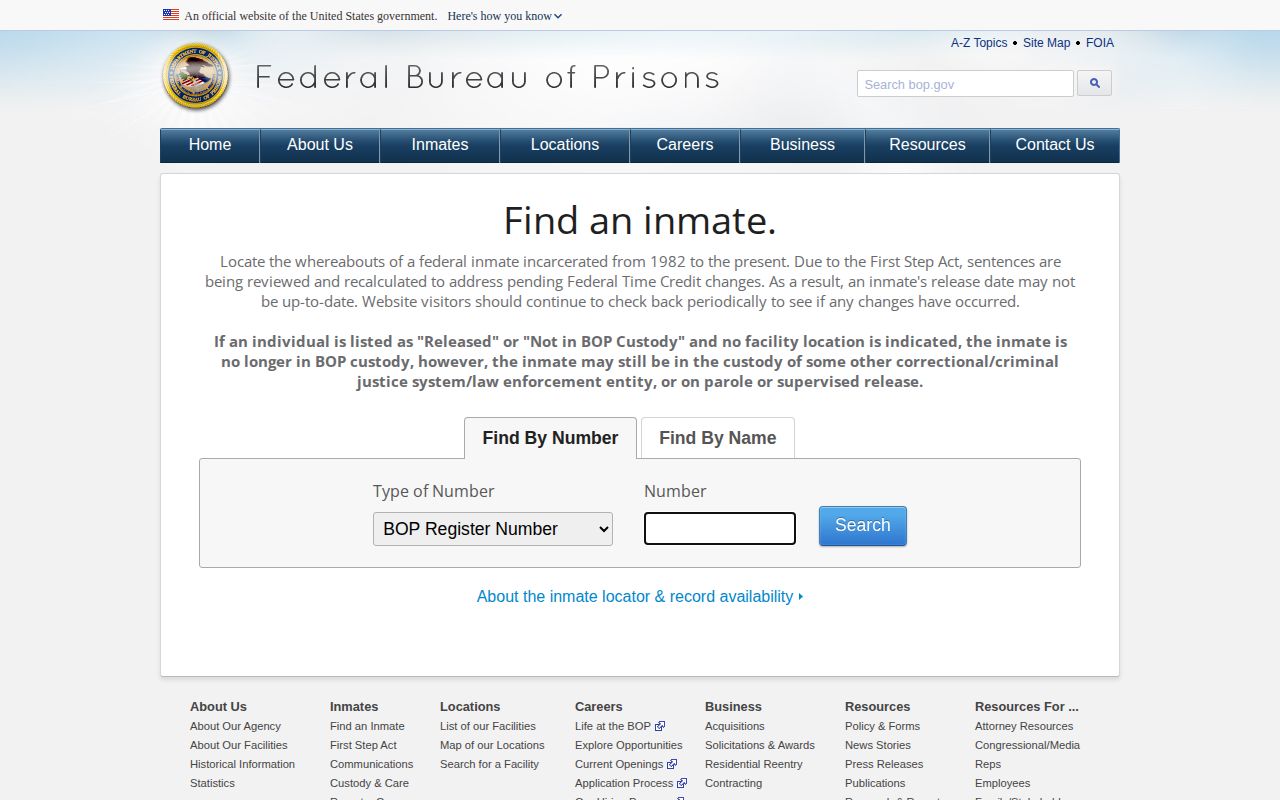
The BOP inmate locator covers federal inmates incarcerated from 1982 to the present. Search by BOP register number, DCDC number, FBI number, or INS number when available. A name search uses first and last name, with optional middle name, race, age, and sex to narrow similar results.
- Choose the federal number search when a reliable identifier is known.
- Otherwise enter the full name and enough optional fields to avoid a false match.
- Read the register number, age, race, sex, release date, and location as displayed.
- Interpret the location label before deciding whether the person left BOP custody.
- Check federal court, supervision, immigration, or local custody when another legal basis may remain.
BOP says its extracts update daily. A past release date or “RELEASED” as location indicates the person is no longer in BOP custody. “IN TRANSIT” means a custody movement, not release. “UNKNOWN” means the term or release date is undetermined. Capture the date checked because the record can change.
Read Federal BOP Release Fields
The locator result is concise. Its date and location are useful status fields, but it is not the complete release transaction or sentencing record. The federal court docket explains the judgment and any supervised-release term. BOP records may provide more detail about the prison episode. A local record remains necessary if the original question is when APD or ACSO transferred the person.
| BOP field or label | What it supports |
|---|---|
| Register number | Stable federal identity match |
| Release date | BOP's recorded or expected custody date |
| Location: RELEASED | No longer in BOP custody |
| Location: IN TRANSIT | Movement within custody |
| Location: UNKNOWN | Undetermined term or release date |
A BOP release date may be historical or projected depending on the record's status. Do not infer that supervision has ended. Federal supervised release is a court-ordered community term after prison and differs from parole. The sentencing court and federal probation records control that question.
Anderson Federal Records Requests
For detail beyond a locator row, the BOP FOIA page directs a request about a former prisoner to identify the person with full name, current address, date and place of birth, and register number. DOJ-361 may be required to establish identity or authorization. Describe the exact admission, movement, release, or discharge record sought rather than asking for every file.
Federal records have distinct custodians. The court holds the judgment and docket. BOP holds sentenced-prison records. USMS manages many pretrial detainees and movements. ICE holds immigration detention information. APD or ACSO holds its own local transfer transaction. A BOP FOIA response cannot replace an Anderson release record when the event in question occurred at a city or county jail.
For federal incarceration before 1982, BOP directs inquiries to the National Archives. Provide full and middle name, date of birth or approximate age, race, and approximate prison dates. A no-result finding for that era should not be read as proof that no federal imprisonment occurred.
Anderson USMS Pretrial Custody
USMS holds court-committed federal prisoners before acquittal or release and before delivery to BOP after conviction. It often uses state, local, private, and federal facilities. There is no general public USMS name-and-release locator. A person moved from APD under a federal hold may therefore be absent from the BOP locator before sentencing or designation.
Use the federal court docket and order to understand the legal event. Contact the District of South Carolina USMS for permissible location guidance. USMS policy withholds personal prisoner histories, photographs, and arrival or departure times from routine public disclosure. Those limits mean an unexplained public absence cannot be converted into a release claim.
- Pretrial custody
- Federal detention before the case ends or before sentence placement.
- Designation
- BOP's assignment of a sentenced person to an institution.
- Transfer
- A move between custodians while confinement continues.
- Supervised release
- A federal court-ordered community term following prison.
Anderson ICE Custody Checks
Use the ICE Online Detainee Locator when immigration custody is plausible. Search with an exact nine-digit A-number plus country of birth. If the A-number has fewer digits, left-pad it with zeros. The alternate route uses exact first and last name plus country of birth, with date of birth as an optional discriminator.
ICE says people released from detention within the preceding 60 days may remain searchable. The system excludes people under 18, can omit some records for security or agency reasons, and may lag intake. No result is therefore not proof of release. Call the Detention Reporting and Information Line at 1-888-351-4024, Monday through Friday except holidays, 8 a.m. to 8 p.m. Eastern, or contact the appropriate ERO office.
An ICE result answers immigration detention, not the criminal disposition. A person can finish BOP custody and enter ICE custody on a detainer. Conversely, disappearance from ICE's locator may reflect release, transfer, a data delay, or an excluded record. Confirm the event with ICE and the relevant court.
Verify Anderson Federal Release Evidence
A federal finding is strongest when each source stays within scope. A BOP locator result is a status lead for sentenced federal custody. The federal judgment and docket corroborate sentence and release authority. BOP's official movement or release record provides direct evidence of the prison event. A receiving ICE, state, or local record may show that confinement continued.
The manifest image shows the correct national locator:
Record the exact label, release date, register number, and observation date. Then ask whether another custodian or supervised-release term followed. If public data conflicts with a certified record, seek correction from the originating office and prefer its corrected record.
Federal and County Release Boundaries
Three different exit times can exist in one Anderson case. APD or ACSO may record a transfer time. USMS may later move the pretrial prisoner. BOP may eventually record a prison release date. Calling all three “the release date” hides the agency and legal status that changed.
Ask a precise question: when did local custody end, when did BOP custody end, and did another custodian or court supervision follow? For the local event, request the Anderson movement record. For the prison event, use BOP and federal records. For supervision, use the sentencing court or federal probation route. For immigration detention, use ICE.
No official source reviewed identified a BOP prison or ICE detention center in Anderson County, nor did it supply local federal release-door logistics. Do not invent a local address, schedule, pickup point, or waiting rule. The facility label on a live record and the responsible federal agency control.